Best Toothbrushes for Braces
By: Dalvir Pannu, D.D.S.
Brushing your teeth is necessary to having a healthy mouth, but when your brush is old, it can’t do its job. Toothbrushes with bent, worn or frayed bristles aren’t going to clean well between your teeth. Take a look at your toothbrush. If you see bristles that are flat, broken or no longer standing straight, it’s time for a replacement. Toothbrushes are also a breeding ground for germs – in fact, researchers at England’s’ University of Manchester found that an uncovered toothbrush can harbor more than 100 million bacteria, some of which are linked to colds, stomach flus and variety of other illnesses. So even if your bristles look fine, it may be time for a replacement.
The best way to limit bacteria and keep your teeth clean and healthy is to replace your brush on a regular basis. The American Dental Association recommends throwing out your toothbrush every 3 to 4 months. If the bristles become frayed, you’re sick or have a weak immune system, you should replace your brush more often.
Still grossed out by the facts? Your toothbrush will never be completely germ free and that’s fine since most germs don’t affect your mouth. The important thing is to make sure that you’re not causing excessive germs. Limit bacteria by storing your brush upright and away from the bathroom counter and toilet, keep it out of contact with other people’s toothbrushes, and allow your brush to dry between uses. For further disinfecting, soak your toothbrush in an antiseptic mouthwash once a week. And don’t forget, if you can’t remember the last time you replaced your brush, it’s time for a new one!
Choosing the best toothbrush
So now that you’ve tossed your toothbrush, you’re going to need a new one. But as anyone who has been to the drugstore knows, this can be an overwhelming experience – especially if you don’t know exactly what you’re looking for. With all of the options out there, it’s hard to know which brush is best for you.
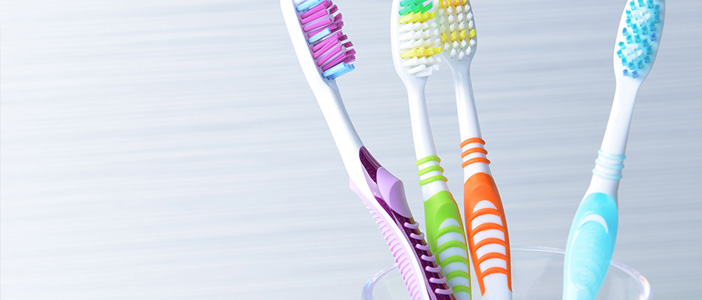
The right toothbrush can make brushing an enjoyable experience and will help prevent tooth decay, dental plaque, dental tartar and even gum disease. Different mouths have different needs, so that is why there are so many different sizes, bristles styles, handles and head shapes available. Here’s a guide to help you understand the different options and which may be suited for you:
Size:
The head of the toothbrush needs to easily access all surfaces of the teeth, especially the ones in the very back of the mouth. Most adult brushes have a head half an inch wide and 1 inch tall – and come with an age recommendation on the package. If you have an extra large or small mouth, look at the brush’s packaging to know if it’s designated for your specific needs. When choosing a size, you want to find something that complements the size of your mouth.
Bristles:
A common misconception is that medium and hard bristles do the best job cleaning, but this isn’t true. Soft, round-tipped bristles are highly recommended because they don’t cause damage to the gums or enamel erosion, plus they are generally the most comfortable. Bristles also come in a variety of styles such as flat, wavy, multi-level and can be made of varying materials. The toothbrush’s package will say what purpose the bristle design serves, so this choice should be based on personal preference.
Handles and Head Shape:
Toothbrushes come in a variety of handles and head shapes for different levels of control. If you’re a hard brusher, consider a flexible handle which helps reduce gum injury. Straight, non-slip grip handles and conventional head shapes are easiest to control while angled handles and diamond headshapes are used to reach hard to clean areas.
Is Electric Better?
It depends. If you find the act of brushing your teeth manually taxing, an electric toothbrush is a great option. Electric toothbrushes make brushing much easier, but they are not necessarily more effective than a regular toothbrush. Electric toothbrushes are also preferred by children because they are not only easier to use, but a bit more fun.
Original Article: http://dentistonair.com/tag/best-toothbrushes-for-braces
Looking for an orthodontist in Beaverton, Oregon? Biermann Orthodontics is a cutting-edge orthodontic practice that serves Beaverton and Molalla, OR, and focuses on providing world-class customer service and efficient treatment. We strive to create stunning smiles in the shortest amount of time without ever sacrificing quality.
Visit our Locations page to find a clinic near you, or schedule an initial consultation.
Biermann Orthodontics
503-690-0722
17885 NW Evergreen Parkway, Suite 200
Beaverton, OR 97006